The Ideas That Can’t Be Unthought
By Karen Ekman
You know how it goes when you have an idea and it clings to your mind. The idea that starts as a wild thought, a “whoah, I wonder if that’d be possible”, and once had—it can’t be unthought. You can try to continue with your original plan, but the idea will linger like a joker on your shoulder, whispering in your ear; “I’m still here!”. You can pretend not to listen, and after enough time convincing yourself to ignore it, the idea may eventually fade—only to be awakened again. So, what do you do?
I had been laid off and figured I had some time to kill. Curious to explore the Balkans, I planned a tour from Greece to Austria. “Great, I’ll visit some friends in Innsbruck and then head home” I thought while drawing a rough route on Komoot, “That’s a solid plan!” But then I zoomed out.
I walked around quite apprehensive, a bit nervous - honestly a little scared - for the first days after thinking the thought. Afraid to say it out loud, I only whispered it to a few close friends. Eventually, though, I realised I didn’t really have any options. It was decided: I was doing it. As I zoomed out on the map, my first thought when seeing the blue line of my original route was, “That’s a perfect halfway mark”. It was only half of the journey. My goal wouldn’t be to bike to Austria, but to Portugal. I was going to cycle across Europe.
I didn’t really have enough time to plan or think things through, but took care of the usual; booked a one-way ticket, got a cardboard box for my bike, and forgot to update the maps on my navigator. By the time I pedalled out of Athens, I still hadn’t figured out why I was doing this or what I was expecting. “I guess I’ll figure it out whilst I go”, I wrote on the first page of my diary.


Answer your own questions
“WHAT are you doing here?! Why do you always get into these situations!” my mind questions as my foot slips on the loose gravel during yet another hike-a-bike. Just a few hundred kilometres into Greece and on my third day of gravel riding, I’m still grappling with the demands of the terrain, and to manage my mind whilst navigating remote areas alone. “Don’t stop, walking is moving, one foot in front of the other” I tell myself.
I had hooked left and descended a forest road into a canyon, without really assessing the vertical climb or road quality ahead. Crossing the Megdovas River at the bottom was merely a refreshing break from the heatwave, so it wasn’t until I started climbing that I checked the map; 1000 vertical meters of rocky gravel up to the Kamaria Pass. Unprepared for, and until now unaware of this climb, I trudged up at a solid 5 km/h, trying but failing to outrun the horseflies, fighting frustration.
Being unaware of a big climb means you also haven’t registered what awaits you at the top. It was nothing like the Greece I thought I knew: an open saddle well above the treeline, greeted only by the curious eyes of cows and cautious shepherd dogs, and ridges spanning far away in all directions. But I found more than beautiful views up there. Layered mountains stretched into the horizon, with a solitary gravel road leading out—it felt like a scene from the adventures I’d long admired, yet not really imagined I’d be riding myself. A sense of belonging washed over me, as if I was exactly where I was meant to be, doing what I was meant to do. I had set off from Athens unable to articulate my reasons, hopes, or expectations for this journey, but now, I glimpsed them in that unexpected challenge and in this unanticipated reward.
These red arrows I was following one day in March this year take you in a big loop around the rocky ridgeline of Cuvier Rempart, a quieter but still popular area next to its busy neighbour Bas Cuvier. Most would see them just like any other set of arrows in this forest, but these ones are special, these are the arrows of Fontainebleau’s first circuit and the start of something unique that continues to this day.
This all probably seems quite confusing to those of you who’ve never climbed or visited the forest. My obsession with these modern day cave paintings may even be confusing to those of you who’ve spent a lot of time there. I like these details however, l like how humans and nature are as one, they simply mark the path, share an idea and say “give this a go”. They work as one and they work together to help turn this forest into a giant playground.


Do try
“Not bikeable” warned a comment on Komoot. “Road closed”, “only suitable for mountain bikes” , said others. I was heading into the Dolomites, known for their towering limestone walls and jagged peaks. High and steep makes finding gravel routes suitable for a packed bike challenging, but not impossible, I firmly believed. By this point in my trip, my confidence had grown, and I had stopped sharing my routes with locals—not out of distrust, but because I mainly received disbelief and warnings. There was always someone, if not everyone, who doubted my plans. I had to consciously choose to trust my instincts rather than their scepticism, applying the same mindset to other cyclists' comments on navigation apps. “If it doesn’t work out, I’ll just turn around,” I thought.
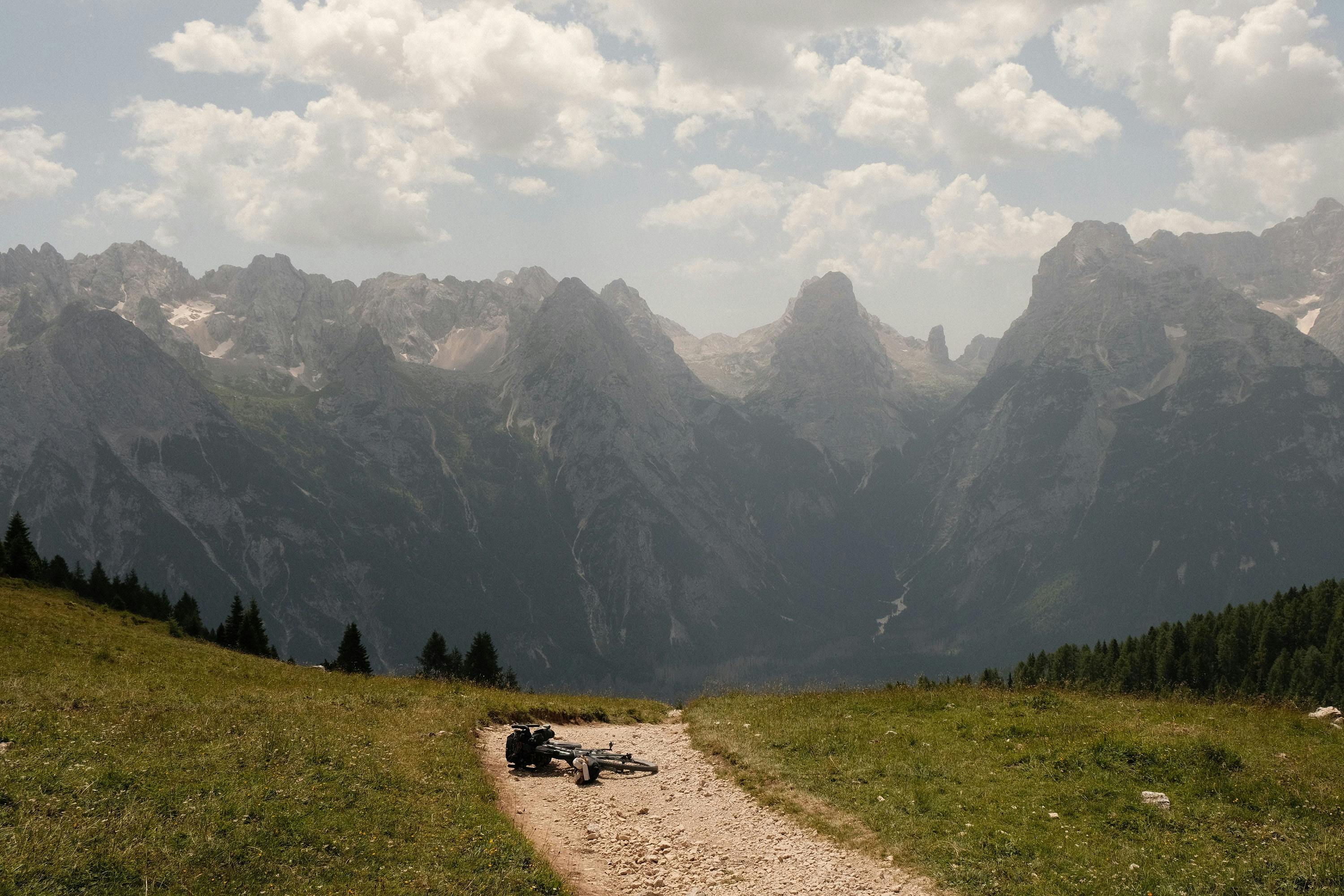
The first obstacle was a section of road work I navigated by carrying my bike through some dugout trenches. The second involved lifting it over a few fences, and the third was a sweaty 9-kilometer hike-a-bike. But in the process, I found some surprisingly remote areas, stumbled into a hidden gorge, biked through overgrown tunnels transformed into art, and navigated empty gravel roads winding through the heart of the Dolomites. Eventually, I reached the 2100-meter pass, greeted by a 360-degree view of those majestic limestone peaks, and found a refuge with almost no other customers. I had discovered a corner of the Dolomites untouched by mass tourism. “Un espresso e uno apfelstrudel, grazie” I ordered in my limited Italian, let out a satisfied sigh, and leaned back towards the wall.

“Everyone has the choice to slow down - but very few realise it…”
… Genni utters without hesitation as I arrive at the Catalonian refuge she runs, Refugi Estanys de la Pera (2357 mos). Three months, and some 5500km in, it had been a long journey, and I had begun to sense a deep, hard-to-define exhaustion. Physically, mentally, energetically—I was tired, no matter how slowly I biked, so I thought that waiting out a few rainy days up here would do me good.
I shared my journey with Genni, mentioning how many countries I had passed through, clearly proud of myself and unconsciously expecting a hint of admiration in her response. It was vague, if even existing at all. I don’t think she was entirely unimpressed, but it was clear this was nothing incredibly extraordinary to her; she was well travelled and used to meeting adventurous souls. The lack of recognition left me momentarily confused until I caught myself.
Despite my attempts to convince myself otherwise, my subconscious still clung to the belief that; more is better. Further, higher, harder, steeper, stronger—is what I felt mattered the most. After years of competitive sports, and an even longer time dealing with social insecurities, this had become my main way of proving my worth, to myself and anyone interested. It’s amusing how quickly confidence wanes when a deeply held value is challenged. What’s truly impressive isn’t how much one can do—some fitness and determination goes a long way—but how honest one can be with oneself. My exhaustion stemmed from a constant push for progress, and while continuing had been and still felt easier, the real challenge was to pause and slow down.


Release, don’t resist
I fled into the toilet, closing all doors behind me, plugged my ears with my noise-cancelling headphones, and waited for the storm in my nervous system to settle. The first time I struggled with it was in Bosnia, it made me cry in the south of France, and now the sound of it—whining past, hour after hour, day and night—had finally overwhelmed me. I couldn’t handle it and could barely find a way to escape it: Cierzo - the northwestern wind of the Navarra plains. It’s born from differing air pressures over the Atlantic and the Mediterranean sea, and is said to be “a wind that fills your mouth and tumbles wagons and armed men”.
It was the only element I hadn't managed to befriend. Physically demanding, but even more taxing on the mind. I experimented with solutions to ease my stress; podcasts or music made it worse as I struggled to concentrate, taking breaks offered immediate relief, but only delayed my escape from the plains. In moments of utter exhaustion I gave in to the stress and screamed out into the void. Yet, all that resistance—fighting, swearing and shouting—somehow only amplified my feelings, allowing them to root themselves even deeper.
Eventually, only a few hundred kilometres from reaching the coast, I found it - the switch by which I could release rather than resist. When I sensed frustration building, I managed to focus on the breath and release the tension. Deep down, I had known all along it wasn’t harder than that, but couldn’t bring myself to do it—to let go. It required practice—hundreds of kilometres spent managing my mind. I hadn’t even realized I was practicing; I felt as though I didn’t know what to do about it. But it became one of the most valuable lessons I learned along the journey: how to let go of what did not serve me.
A kaleidoscope of colors
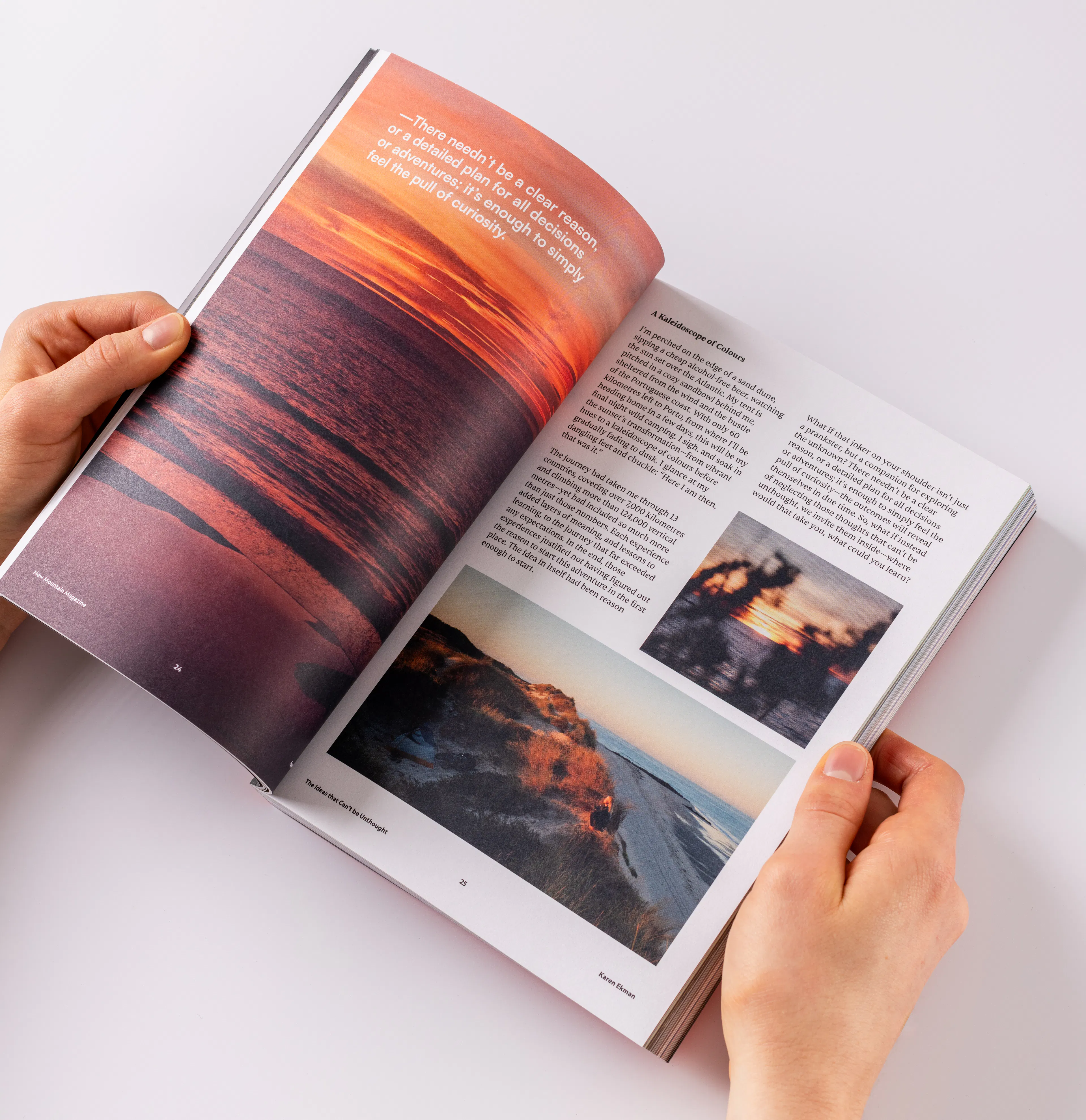
I’m perched on the edge of a sand dune, sipping a cheap alcohol-free beer, watching the sun set over the Atlantic. My tent is pitched in a cozy sandbowl behind me, sheltered from the wind and the bustle of the Portuguese coast. With only 60 kilometres left to Porto, from where I’ll be heading home in a few days, this will be my final night wild-camping. I sigh, and soak in the sunset’s transformation—from vibrant hues to a kaleidoscope of colours before gradually fading to dusk. I glance at my dangling feet and chuckle: “Here I am then, that was it”.
The journey had taken me through 13 countries, covering over 7,000 kilometres and climbing more than 124,000 vertical meters—yet had included so much more than just those numbers. Each experience added layers of meaning, and lessons to learning, to the journey that far exceeded any expectations. In the end, those experiences justified not having figured out the reason to start this adventure in the first place. The idea in itself had been reason enough to start.
What if that Joker on your shoulder isn’t just a prankster, but a companion for exploring the unknown? There needn’t be a clear reason, or a detailed plan for all decisions or adventures; it’s enough to simply feel the pull of curiosity—the outcomes will reveal themselves in due time. So, what if we, instead of neglecting those thoughts that can’t be unthought, invite them inside instead—where would that take you, what could you learn?

This article was written exclusively for New Mountain Magazine Issue One. All images copyright Karen Ekman.